
Information for Professionals Before Assembly
Traditional timber joints are fundamental to the way oak-framed buildings are designed and constructed. From the eaves beam of an oak-framed garage to the structural timbers within a garden room, each joint has a specific job to do in connecting individual components and allowing the completed frame to perform as intended.
These aren’t details that need to be designed and cut from scratch once the timber reaches your site, however. We combine traditional oak-framing principles with modern precision engineering, manufacturing the required joints as part of the bespoke frame before it is delivered.
This helps simplify the assembly of everything from garages and garden rooms to porches, pergolas, gazebos, and other oak-framed structures, while retaining the traditional jointing techniques associated with oak-frame construction. Below, you can find more information about some of the joints we use, why they’re specified, and what you need to know when assembling one of our frames – or to pass on to your clients.

Scarf Joints
A scarf joint connects two pieces of timber end to end, enabling a structural member to achieve a greater overall length than would be practical or possible using one continuous piece of timber.
You’ll commonly find scarf joints used for eaves beams and purlins within our frames. However, where the joint is positioned is important. A scarf joint should sit at a point of low bending stress, which means it will typically be positioned close to a post or brace.
There are several forms of scarf joint used within traditional timber framing. The two you’ll most commonly encounter in our work are bridle scarf joints and side-halved scarf joints.
Bridle Scarf Joints
We use bridle scarf joints on eaves beams. Eaves beams often need to span considerable distances, particularly on larger structures such as a multi-bay oak-framed garage or a frame for an oak-framed complex. A bridle scarf allows separate timbers to form the required overall beam length while creating an appropriate connection between them.
The joint and its position are determined as part of the frame design, so trade customers receive components prepared for their intended locations within the structure.
Mortise and Tenon Joints
The mortise and tenon is one of the fundamental joints used within traditional timber framing. The mortise is the cavity cut into one timber, while the tenon is the corresponding projection formed on another. The tenon fits into the mortise to create the connection.
Mortise and tenon joints are commonly associated with joining two pieces of timber at right angles, but they can be used in other configurations across an oak frame. We use them throughout our frames, including on curved knee braces.
This versatility makes the principle suitable for many different oak-framed structures, whether you’re assembling a porch, garage, or a much larger building.
Standard Mortise and Tenon Joints
Many connections throughout our frames are standard mortise and tenon joints, and each is manufactured as part of the frame before delivery. This removes the need to form them from unworked lengths of oak on site. Instead, you can focus on following the provided instructions that come with every kit.
Housed Mortise and Tenon Joints
Some areas of a frame call for a variation on the standard joint. For example, we use housed mortise and tenon joints for oak floor joists. This further demonstrates how joint selection is determined by the role of the timbers being connected, rather than applying the same detail throughout every part of a building.
Lap Joints
Lap joints are formed where sections of two timbers overlap to create a connection. We use both half-lap and stopped half-lap joints at corners within our frames.
Half-Lap Joints
In a half-lap joint, material is removed from the connecting timbers so that they overlap one another at the joint. This provides a straightforward means of forming certain corner connections while maintaining the intended relationship between the structural members.
Stopped Half-Lap Joints
A stopped half-lap follows the same underlying principle but terminates within the timber rather than continuing through its full width or length at the connection. Where forces are acting to pull the two beams apart, these connections can also be secured using stainless steel pins.
As with every structural connection within the frame, the appropriate detail will depend on where the joint is being used and what it needs to achieve.
How are Traditional Oak Joints Secured?
Cutting the joint is only one part of creating a structural connection. The individual timbers also need to be held together appropriately. Different areas of an oak frame can therefore use oak pegs, stainless steel pins, bolts, or plates, depending on the requirements of the connection.
Seasoned Oak Pegs and Drawbored Joints
Most of the traditional joints within our frames are secured using seasoned oak pegs. These connections are drawbored to help pull the timbers together. Rather than the peg holes aligning neutrally before assembly, the detail allows the peg to draw the joint together as it is driven into position, helping to create the required connection between the components.
It is a traditional principle of timber-frame construction that continues to work effectively alongside modern precision manufacturing.
Stainless Steel Pins
Some connections require additional strength, particularly where forces could act to pull two beams apart. In these locations, we may specify stainless steel pins rather than relying solely on traditional oak pegs.
Bolts and Plates
Certain joints need additional mechanical fixings to perform their structural role, not just to look aesthetically pleasing. King post joints, for example, may require bolts. Oak pegs, stainless steel pins, and bolts each have applications within a frame, and the appropriate solution depends on what the particular connection needs to achieve.
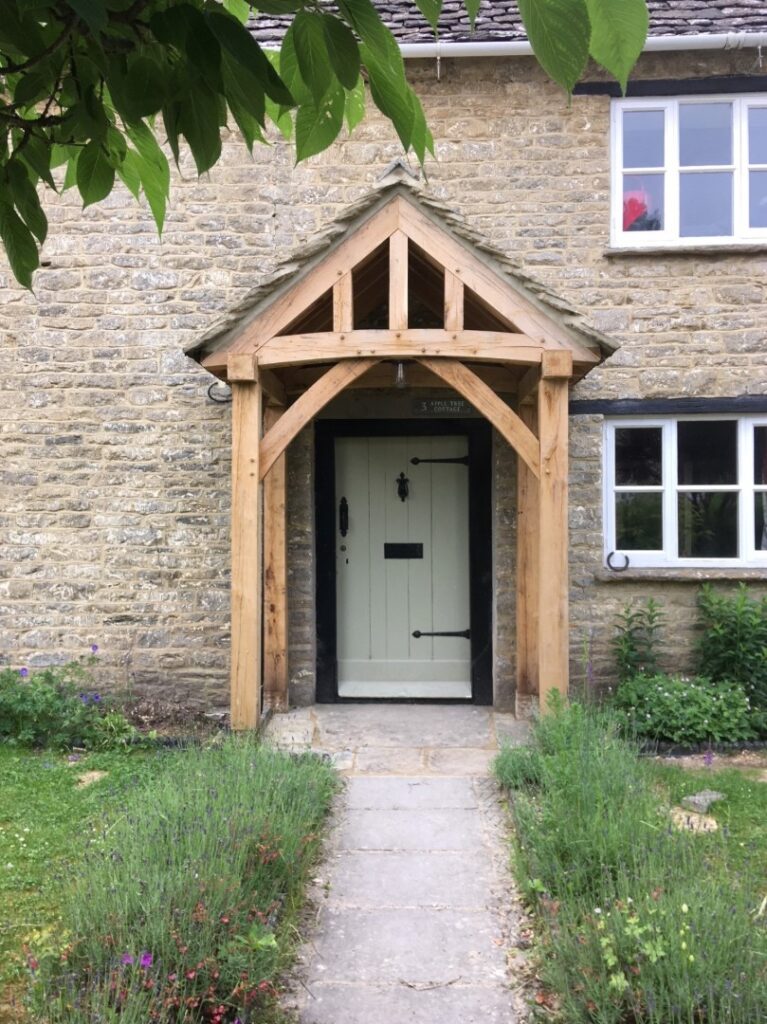
Precision-Machined Joints for Straightforward Site Assembly
Traditional jointing doesn’t mean that every joint needs to be cut by hand on site. We combine the established principles of oak-frame construction with modern precision engineering. Our joints are machine-cut as part of a carefully managed manufacturing process, providing accuracy and consistency required across every frame.
This has several practical advantages. The first is that any complex joint manufacture is carried out before the frame arrives, helping to reduce the amount of fabrication required on site. It also means components are produced for their specified positions within the agreed design, while full assembly instructions are supplied with every frame to help your team understand how it goes together.
This approach is equally valuable whether you’re delivering an oak frame lean-to or porch for a residential client, installing a pergola as part of a landscaping project, or working with a substantially larger garage or garden room.
Joint Design That Accounts for Green Oak
Successful joint design also needs to take the material being used into account. Green oak naturally changes as it dries. Traditional oak framing has long accommodated these characteristics, and our designs follow the same principle, allowing for the natural shrinkage of green oak as part of the construction.
This is particularly important because oak isn’t simply another generic construction material. Its properties are part of what gives an oak frame its distinctive character and longevity, but those same properties need to be properly understood when the frame is designed and manufactured.
Whether the finished project is a gazebo, an extension, or a large complex, the jointing needs to work with the characteristics of the timber rather than against them.
If you need more information about the material itself, see our guide on What You Need to Know About Oak.

Quality Starts Before the Joint is Machined
The accuracy of a joint is only part of the picture. The timber being machined also needs to meet the appropriate requirements for its intended use. We employ professional timber graders and follow a closely managed manufacturing process designed to provide consistency and precision across our frames. Our approach covers 22 separate industry standards and delivers products to BM TRADA Q-Mark-equivalent level.
This attention to quality begins before machining. Timber needs to be assessed and selected appropriately so that the finished frame provides both the structural performance and visual standard expected from the project.
Customers looking for further technical information can also explore our guidance on:
- Oak Quality Requirements
- What Oak Grade Are You Buying?
- Undersized or Oversized Timbers
- Quality Assurance
Oak Frames Manufactured Ready for Your Project
From the mortise and tenon joints found throughout traditional oak framing to scarf joints that make longer structural members possible, the details within an oak frame all contribute to how the completed building fits together and performs. Working with a precision-manufactured kit means you don’t need to start with raw lengths of oak and manufacture every complex traditional joint yourself.
We combine traditional framing principles with modern precision engineering to produce bespoke oak frames for projects across the UK. No matter what your client’s plans call for, we’ll manufacture the frame to the agreed design and supply it with full assembly instructions ready for your project.
Have an upcoming oak-frame project? Use our Online Builder to configure your requirements and get a quote, or call or email our team to discuss what you need.


